
How Much Do Solar Panels Save on a $200, $300, or $400 Electric Bill?
Key Takeaways
How much do solar panels save? The answer depends on your electricity use, solar system size, roof conditions, utility rate plan, and how much solar energy you use directly in your home.
A household spending $200, $300, or $400 per month on electricity has different energy needs, so the solar system should be sized around actual annual electricity consumption rather than the monthly bill alone.
Solar can reduce the amount of electricity you need to purchase from the grid, but homeowners should not assume their utility bill will disappear completely.
Battery storage can allow homeowners to store excess daytime solar production and use more of that energy later instead of drawing electricity from the grid.
The easiest way to get a starting estimate is to use Sandbar Solar & Electric's Solar Savings Calculator.
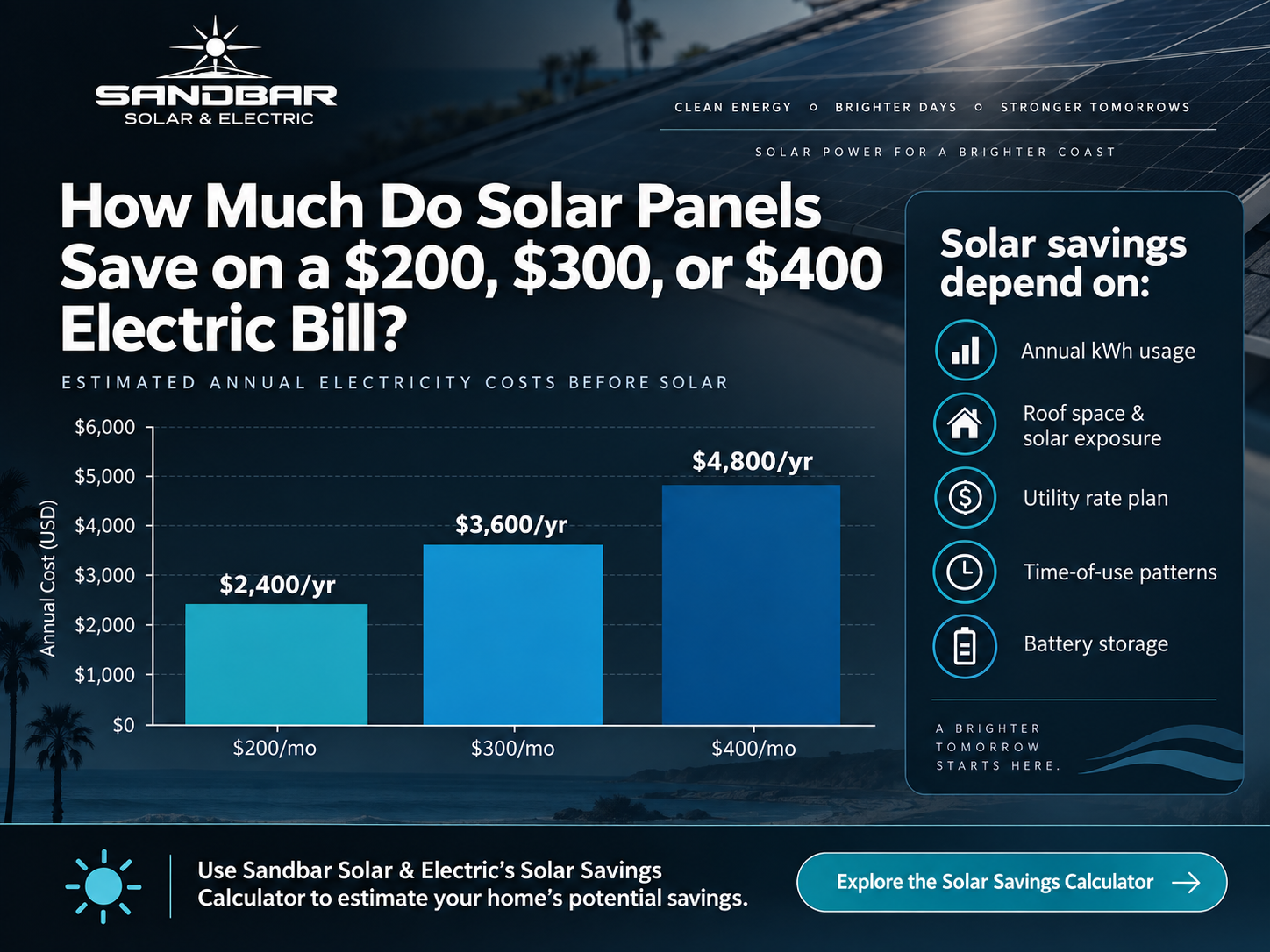
how much do solar panels save on electricity bill
If your electric bill is regularly $200, $300, or $400 per month, you may be wondering: how much do solar panels save each month?
There is no single answer. Your savings depend on your electricity use, when you use power, your property’s solar potential, and how your system is designed.
For homeowners in Santa Cruz, Monterey, Santa Clara, and nearby Central Coast communities, understanding these factors can help provide a clearer picture of how solar may reduce monthly electricity costs.
How Much Do Solar Panels Save on Electricity?
Solar panels primarily save money by generating electricity that your home can use instead of purchasing that electricity from your utility or electricity provider. During sunny hours, your solar system produces electricity. If your home is consuming electricity at the same time, that solar production can directly serve some of those needs.
As a result, the amount of electricity purchased from the grid may decrease.
However, how much solar panels save varies considerably between households because two homeowners with the same $300 monthly bill may have very different properties and energy habits.
For example, one homeowner may use most of their electricity during the daytime, when solar panels are actively producing energy. Another household may use considerably more electricity in the evening after solar production drops. That difference matters when estimating potential savings.
What If Your Electric Bill Is Around $200 Per Month?
A $200 monthly electric bill equals about $2,400 per year, although costs can vary seasonally. Solar can reduce grid electricity use, but system size should be based on actual annual energy consumption rather than the monthly bill alone.
Reviewing 12 months of electricity usage helps account for seasonal increases caused by heating, cooling, pool equipment, and other high-demand appliances.
Pro Tip: Review your electricity usage in kilowatt-hours (kWh), not just the dollar amount of your bill. This provides a more accurate starting point for estimating the solar system size your home may need.
What If Your Electric Bill Is Around $300 Per Month?
A $300 average monthly electric bill represents about $3,600 in electricity costs over a year. At this point, it becomes especially important to understand what is driving your energy consumption.
Higher usage may come from:
Electric heating and cooling
An electric vehicle
Level 2 EV charging
Pool or spa equipment
Electric water heating
Large appliances
Home offices
Additional occupants
Older or less efficient electrical equipment
A properly sized solar system can produce electricity to offset part of this demand. However, installing panels without reviewing when and how the home uses electricity can result in a system that does not align well with the homeowner's actual needs.
That is why Sandbar Solar & Electric looks beyond the dollar amount on the bill when planning a residential solar system.
What If Your Electric Bill Is Around $400 Per Month?
A $400 monthly electric bill equals approximately $4,800 per year, although actual costs may vary by season. At this level of energy use, solar can help reduce the amount of electricity purchased from the grid, but the home may require a larger system to meet its needs.
System design should consider available roof space, shading, roof orientation, panel capacity, and whether electrical upgrades are needed. Future energy use should also be included in the planning process.
Adding an EV, heat pump, electric water heater, pool, or home addition can increase electricity demand. Accounting for these changes before installation can help ensure the solar system is better suited to the home’s long-term energy needs.
Why Your Electric Bill Alone Cannot Predict Solar Savings
Your electric bill tells you how much you paid, but it does not tell the entire story. Several factors influence how much solar panels save.
Your Annual Electricity Consumption
Kilowatt-hour usage is one of the most important numbers when estimating solar needs. Rather than looking at only your most recent month, reviewing a full year of electricity consumption provides a clearer picture of how much energy your household actually uses.
Roof Space and Solar Exposure
A property may have enough electricity consumption to justify a larger solar array but limited space to install it. Chimneys, vents, skylights, roof edges, shading, and different roof angles can all affect where panels can be placed.
When You Use Electricity
The time of day electricity is used can affect overall solar savings. Under California’s Net Billing Tariff, solar energy used directly by the home can reduce electricity purchased from the grid, while excess energy sent back to the grid receives export credits.
Battery storage can also help by storing excess solar energy for use during higher-demand or higher-cost periods. As a result, potential savings depend on both how much solar energy the system produces and when that energy is used.
Your Utility Rate Plan
Electricity rates vary by utility provider, rate plan, and time of use. Because of these differences, two homes with similar electricity consumption may have different monthly bills and may experience different levels of solar savings.
Future Electricity Needs
Your current electricity usage may not be the same five years from now.
Before installing solar, consider whether you plan to add:
An EV or additional EV
Level 2 EV charging
Electric heating
A heat pump
Electric water heating
A pool or spa
Additional living space
Other major electrical equipment
Designing around expected future needs can help prevent your system from becoming undersized as household electricity consumption changes.
Can Solar Completely Eliminate a $200, $300, or $400 Electric Bill?
Solar can significantly reduce electricity purchased from the grid, but it does not always eliminate the electric bill entirely. Utility charges, grid usage, rate structures, seasonal production, shading, weather, roof orientation, and household energy use can all affect the final amount due.
Because solar production varies throughout the year, the more useful question is how much electricity a property can realistically generate and how much of the home’s grid consumption that production can offset.
Does a Higher Electric Bill Mean Greater Solar Savings?
A higher electric bill may create greater potential for solar savings, but the results depend on the property. A home spending $400 per month has more electricity use to offset than a home spending $100 per month, yet roof space, shading, orientation, and overall solar exposure still affect how much energy the system can produce.
Because these conditions vary from one property to another, solar savings should be evaluated based on the home’s actual energy use and site conditions.
Can Battery Storage Help You Get More From Your Solar?
Battery storage allows homeowners to save excess solar energy for later use, including evenings when solar production is lower. Under California’s Net Billing Tariff, this can help households use more of their own solar energy instead of exporting it to the grid.
Battery systems can also provide backup power for selected essential circuits during outages, adding both energy management and outage protection to a solar system.
How Do You Estimate Your Actual Solar Savings?
Instead of trying to calculate savings based only on a monthly electric bill, start with your actual property and electricity consumption.
Sandbar Solar & Electric's Solar Savings Calculator provides a useful starting estimate based on your home's solar potential.
The calculator can help you begin answering questions such as:
How much solar could my roof produce?
What could my potential solar savings look like?
How might my electricity usage affect the system I need?
However, an online calculator is still an estimate. Roof orientation, shading, panel placement, local weather, electrical equipment, battery goals, and future electricity use can all change the final system design.
Talk to Sandbar Solar & Electric About Your Solar Options in Monterey and Nearby Areas
If you’re considering solar and want to understand how it could work for your home, Sandbar Solar & Electric can help. Our team can review your energy use, property, solar goals, and potential battery storage needs to recommend a system that fits your household.
Contact Sandbar Solar & Electric today to learn more about solar energy, explore your options, and find out how much you may be able to save.
Frequently Asked Questions
How much do solar panels save per month?
There is no fixed monthly amount. Solar savings depend on your electricity consumption, system size, solar production, rate plan, roof conditions, and how much solar energy you use directly in your home. Reviewing 12 months of electricity usage provides a better starting point than looking at a single monthly bill.
Can solar reduce a $300 monthly electric bill?
Solar can reduce the amount of grid electricity a household needs to purchase, which may lower a $300 monthly electric bill. However, the actual reduction depends on the home's energy use, system size, solar exposure, utility rate plan, and when electricity is consumed.
Is solar worth considering if my electric bill is over $400 per month?
A consistently high electric bill can make it worthwhile to evaluate solar because the household is purchasing a significant amount of electricity from the grid. However, the property's solar exposure, available installation space, electricity usage, system cost, and long-term plans should all be considered before making a decision.
Can battery storage increase the value of my solar system?
Battery storage allows available solar energy to be stored for use later, which can help homeowners use more of the electricity their solar panels produce. Batteries can also provide backup electricity to selected circuits during an outage when the system is designed for backup operation.
Which solar installers offer battery backup and energy storage in California?
Homeowners should look for an installer that can evaluate solar production, battery capacity, electrical equipment, critical loads, and backup priorities as one complete system. Sandbar Solar & Electric provides residential solar, battery storage, and electrical solutions throughout Santa Cruz, Monterey, Santa Clara, and other Central Coast service areas.
What should I look for in a solar company for power outage protection and battery backup?
Look for a contractor that considers more than battery capacity alone. A well-designed backup system should account for essential circuits, household electricity consumption, solar production, electrical panel capacity, battery storage, and how long you want important loads to remain powered during an outage.
What battery backup system should I pair with solar in Monterey or Santa Clara County?
The appropriate battery system depends on your home's energy use, existing solar equipment, desired backup duration, electrical system, and which appliances or circuits you want to support. A professional solar and electrical assessment can help determine the appropriate battery capacity and system configuration.