
Key Takeaways
Solar panels alone generally cannot power your home during an outage. Backup requires compatible equipment that safely disconnects from the grid.
Backup duration depends on available battery energy and appliance use. Running fewer appliances can extend runtime.
Essential-circuit backup powers selected loads. Whole-home backup may require more batteries and load controls.
Sandbar offers Tesla Powerwall, Enphase, Lunar, and Franklin aPower systems. The best option depends on your home and backup priorities.
Local conditions affect solar recharging. Fog, shade, and shorter winter days matter when sizing systems in Santa Cruz and Monterey County.
Solar battery backup can keep essential appliances running during an outage, but system design and energy use determine what stays on and for how long. Sandbar Solar & Electric helps homeowners in Santa Cruz and Monterey County choose solar and storage systems that fit their backup needs.
How Does Solar Battery Backup Work?
Solar panels generate electricity during daylight hours. When production exceeds what your home needs, a compatible battery system can store some of that surplus for use later.
During an outage, a backup-capable system isolates the home’s backed-up circuits from the utility grid. The battery then supplies those circuits within its operating limits. With a compatible design and sufficient sunlight, the solar panels can also help power the home and recharge the battery.
A standard grid-connected solar installation generally shuts down when utility power fails. Consequently, having solar panels on the roof does not automatically mean your home has outage protection. PG&E explains this distinction in its solar outage guidance.
Why Local Conditions Matter Around Monterey Bay
A battery plan should reflect the home where it will operate. A shaded property near the Santa Cruz Mountains may have different charging opportunities from a home with an open roof in Watsonville or Salinas.
Likewise, a coastal home in Capitola or Pacific Grove should not rely on a production estimate that assumes clear skies every day. Fog, winter cloud cover, roof orientation, and nearby trees all affect how much solar energy becomes available to recharge storage.
Your electrical needs matter just as much. For example, a home in the San Lorenzo Valley with a well pump needs an assessment of the pump’s operating demand and startup requirements. Meanwhile, a Monterey household that wants refrigeration and a few outlets backed up may need a different configuration.
For local planning, consider:
Overnight needs: Which appliances must run until solar production resumes?
Seasonal charging: How much electricity can the roof generate during shorter winter days?
Property equipment: Do pumps, heating systems, or other motors require extra starting power?
Outage priorities: Is the goal a few hours of essential power or a longer period with carefully managed use?
These questions make a consultation more useful than choosing a battery based only on a product brochure.
Essential-Circuit Backup or Whole-Home Backup?
Essential-Circuit Backup
An essential-circuit system supplies a selected group of household loads. Those might include refrigeration, several lights, communications equipment, and designated outlets.
By limiting demand, homeowners can stretch the energy available in storage. However, circuit selection requires care: an outlet you expect to use during an outage must actually belong to the backed-up portion of the electrical system.
Whole-Home Backup
Whole-home backup can make power available across more of the house, but it does not mean every appliance can run together indefinitely. Electric ovens, water heaters, heat pumps, and EV chargers can quickly increase demand.
Depending on the property, broader backup may require additional batteries, load controls, or electrical upgrades. Therefore, ask two separate questions: “Can the system start and run these appliances?” and “How long can it keep them running?”
How Long Does Solar Battery Backup Last?
Backup duration depends on the energy available when the outage begins and the average demand of the equipment running.
A useful planning equation is:
Estimated runtime in hours = available battery energy in kWh ÷ average backed-up demand in kW
The examples below assume 10 kWh available to supply household loads, with no solar recharging during the period.
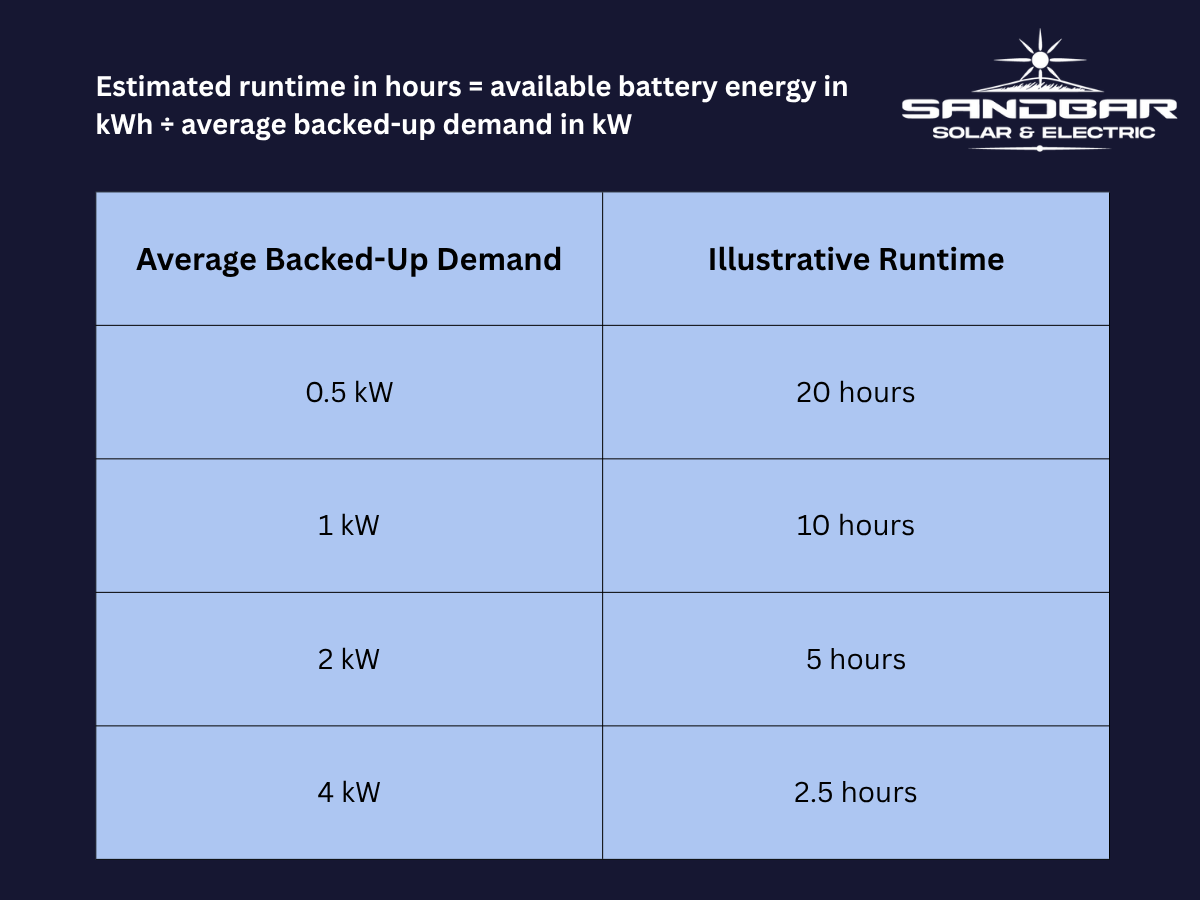
Solar Average Backed-Up Demand and Illustrative Runtime
These are arithmetic examples, not performance promises or specifications for a particular product. Actual results depend on charge level, conversion losses, temperature, equipment limits, battery condition, and changing appliance use.
Also, energy capacity and power output describe different capabilities. Kilowatt-hours indicate stored energy, while kilowatts describe how much power the system can deliver at a moment. A battery may hold enough energy for several hours yet still lack the output needed to start a particular motor.
To begin exploring different loads, try Sandbar’s battery backup calculator, then request a property-specific assessment.
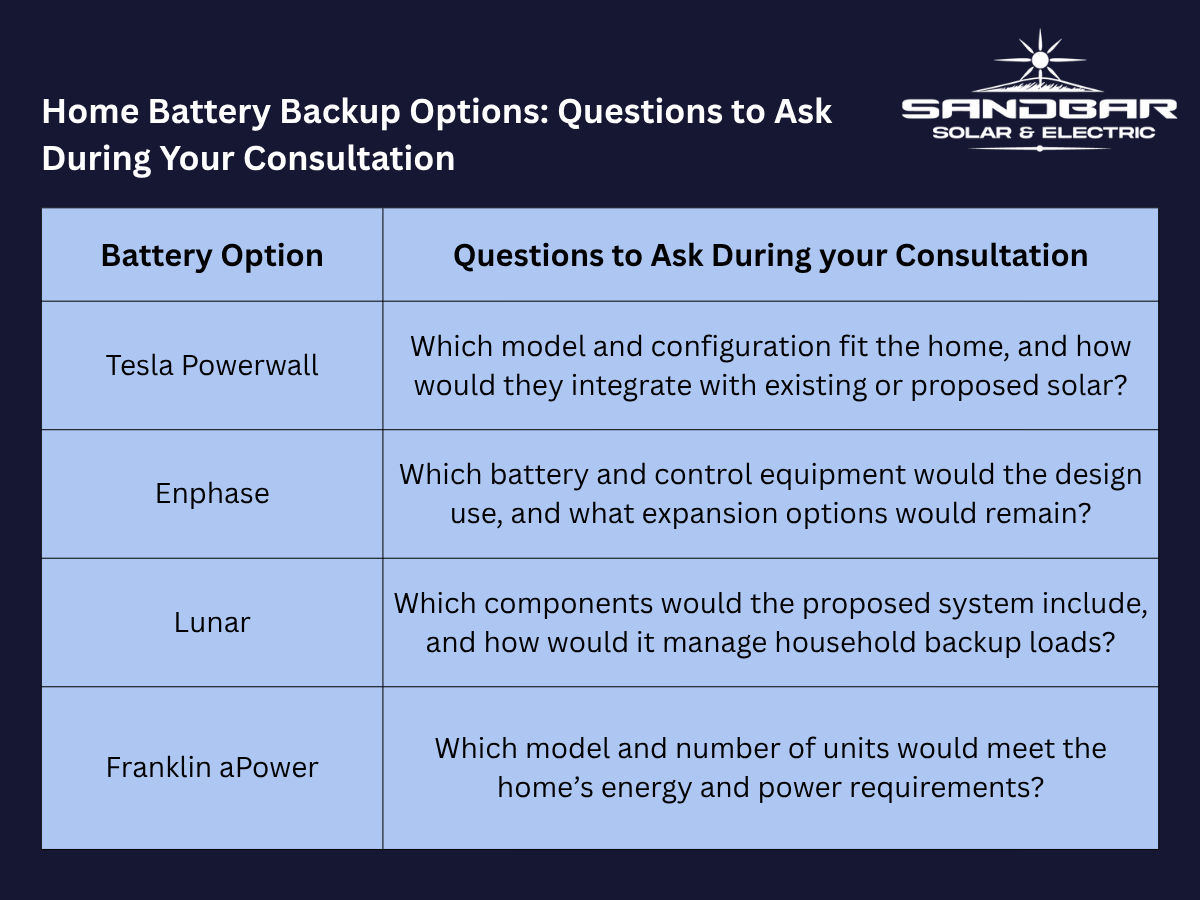
Home Battery Backup Options
For every proposal, compare usable capacity, continuous output, starting-load capability, warranty terms, installation requirements, and monitoring features. Confirm current model availability with Sandbar before making a final selection.
Can You Add a Battery to Existing Solar Panels?
Often, yes, although compatibility requires a review of the existing installation.
Before recommending a retrofit, an installer should examine the solar inverter, electrical panel, system age, monitoring equipment, and utility interconnection arrangement. That review helps identify whether the project needs additional controls, wiring changes, or other upgrades.
If your home already has solar in Aptos, Scotts Valley, Monterey, or another nearby community, gather your original installation documents and recent electricity bills before the consultation. Also, explain which appliances you want backed up.
For an older net-metered system, ask how the proposed scope could affect its utility agreement, particularly if the project also changes solar capacity.
Can Battery Storage Help With Everyday Electricity Use?
A battery can serve a daily purpose as well as an outage role. For example, a compatible system can store daytime solar production and supply electricity later, reducing grid purchases during selected hours.
California’s Net Billing Tariff uses a different approach to export compensation from older net-metering programs. As a result, the relationship between electricity used at home, electricity exported, and electricity purchased deserves attention when planning storage. The California Public Utilities Commission’s net metering and net billing overview explains the framework.
Any savings estimate should use the household’s actual rate plan and consumption patterns. In addition, discuss backup reserve settings: using more stored energy each evening can leave less available when an unexpected outage begins.
What Should a Solar and Battery Proposal Include?
Before approving an installation, request a clear explanation of:
The equipment models, battery quantity, and usable storage capacity.
The circuits and appliances included in backup.
Power limits and any restrictions on running large appliances together.
Runtime estimates with stated assumptions about demand, charge, and solar production.
Required electrical work, permits, inspections, and utility coordination.
Monitoring setup, warranty coverage, and service responsibilities.
Sandbar Solar & Electric describes a process that includes energy assessment, critical-circuit identification, system design, installation, and activation support. Its Santa Cruz County service page also outlines in-house coordination of design, engineering, permitting, installation, and commissioning.
For homeowners comparing Central Coast installers that combine solar panels and energy storage, those project responsibilities deserve as much attention as the battery itself.
Plan Your Solar Battery Backup With Sandbar Solar & Electric
A reliable backup plan starts with what matters to your household: which appliances need power, how long they need to run, and what your property can support.
With more than 20 years in business, Sandbar Solar & Electric helps homeowners across Santa Cruz and Monterey counties evaluate solar and battery storage options. Sandbar’s website displays an Enphase Gold Installer designation and California contractor license #846294.
Whether you’re planning new solar in Santa Cruz, adding storage in Aptos, or comparing backup systems for a Monterey County home, start with advice tailored to your energy needs.
Schedule a solar and battery consultation today!. Bring a recent electricity bill and a list of your priority appliances so the discussion can focus on your home’s needs.
Service areas: Santa Cruz, Monterey, Santa Clara, Alameda, San Benito, and San Mateo counties
Frequently Asked Questions About Solar Battery Backup
Will solar panels keep my house running during a PG&E outage?
Standard grid-connected solar panels generally will not. Outage operation requires a system specifically designed to supply household loads while safely isolated from the grid.
Can one solar battery power an entire house?
It may support a particular home’s selected needs, but there is no universal answer. The battery’s output, available energy, appliance startup demands, and household usage determine whether one unit is sufficient.
Can solar recharge a battery during a multiday outage?
Yes, with a compatible backup system and enough solar production. However, household consumption and limited sunlight can reduce the energy available for charging, so multiday operation requires careful sizing and load management.
Does coastal fog make solar battery backup ineffective?
No. Fog can reduce solar production and slow recharging, but a charged battery can still supply its backed-up loads within its limits. A realistic design should account for seasonal production rather than assuming ideal sunlight.
Can a battery run a well pump or heat pump?
Possibly. An installer must check the appliance’s electrical requirements, including startup demand, against the proposed system’s capabilities. Include these appliances in the assessment rather than assuming they will work.
How much does solar battery backup cost in Santa Cruz or Monterey County?
The installed price depends on the battery model, number of units, electrical work, backup configuration, and site requirements. Ask Sandbar for an itemized proposal based on your property and the appliances you want to support.
Who installs solar panels and battery backup in Santa Cruz and Monterey County?
Sandbar Solar & Electric offers residential solar and energy storage services in both counties. Its listed battery options include Tesla Powerwall, Enphase, Lunar, and Franklin aPower.